This song is one I have been thinking of doing for a while now, I think it is good to create a music video for because it has lots of different elements to it. The lyrics of the song itself are ones that would be easy to build a story to make a narrative based video. As well as this the music contains elements of fast, and elements of slow music, meaning that it would look very interesting as I could use a large variety of clips to go along with the music.
Twin Atlantic- Brothers and Sisters
For this song, I really like the beat of it and how the lyrics are very meaningful. The song is easy to follow, so the viewer wouldn't have to think too much about the story when watching video. Again, for this song I think that it would be best as a narrative based video because the lyrics almost tell a story already, and it would probably be relatable for lots of people
Sam Smith- Stay With Me
This song would be very good to create a narrative based video for, it has a good pace and a good soft sound to the music, which means that it would again be easy to listen to. The song is mostly slow paced, although it has a good, very consistent, beat which would make editing very effective with the clips showing in time with the music.
I have found some music videos from several different genres, and watched them myself as well as shown them to other people, in order to identify the typical conventions of music videos in some of these genres. The music videos I chose are listed below, with links to each of them. I asked some people, after watching videos I chose for each of the genres, 'What do you see as the conventions of different genres in music videos?', and I have written some of the feedback they gave below.
Pop:
One Direction- 'Kiss You'
Katy Perry- 'Roar'
First, we looked at pop music videos, for this we watched One Direction-'Kiss You', and Katy Perry-'Roar'. The song by Katy Perry is considered 'Power Pop', and although they are considered different types of Pop, we still found similar conventions. In general, the feedback was that Pop music videos contained very unrealistic concepts, e.g. taking a selfie with a monkey. Also, people said that Pop music videos were very overacted and 'cheesy', perhaps wearing costumes, as opposed to normal clothing, and with lots of props. In terms of the lighting, in most pop videos it is usually very bright and colourful, with artificial looking lighting.
Rock:
Panic at the Disco- 'This is Gospel'
Oasis- 'Wonderwall'
Next, we looked at Rock music, watching Panic at the disco-'This is Gospel', and Oasis-'Wonderwall'. Again, within this genre the two songs are fairly different, with the Panic at the disco considered to be 'Alternative Rock'. In rock videos, people said that there was a lot more focus on the main singer rather than a band or on other actors in the video. As well as this, the videos contained a lot of black and white shots, and generally dull or dark lighting. The clothing in these videos was fairly casual and not over the top, as well as this they generally told some kind of story of love, or of someone's life spiraling out of control.
R&B:
Rihanna- 'Umbrella'
Estelle- 'American Boy'
For R&B music, we watched Rihanna-'Umbrella', and Estelle-'American Boy'. People gave feedback for these music videos that they were generally very choreography based, involving a lot of dancing from the main artist, with everything else being fairly simple. The costumes in these videos were very classy and with quite large jewellery, and often very intricate hair and makeup. The costumes and the set were usually black and white, perhaps with a hint of gold or silver. Most of the time, these videos were very fast paced, with several costume changes throughout the video. Country:
Taylor Swift- 'Fifteen'
Lady Antebellum- 'Need You Now'
The next videos we watched were Country songs, and they were Taylor Swift-'Fifteen', and Lady Antebellum-'Need You Now'. Both of these videos have a similar sound to them, and also contained lots of similar conventions, although the stories they were telling were very different. In both of these videos, the clips often had filters over them to change the lighting, making it look fairly vintage. The clothing was always very simple and casual, looking quite elegant. Country videos are often very narrative based and also they were quite slow paced. Hip Hop:
Outkast- 'Hey Ya'
Cee Lo Green- 'Forget You'
Finally, we watched Hip Hop videos, the two we watched were Outkast-'Hey Ya', and Cee lo Green-'Forget You'. The two songs tell very different stories, although have a similar vibe to them, and have fairly similar videos. The feedback for Hip Hop videos was that they had a lot more people in them than other genres, so there was less focus on the artist, and there was focus on actors in the video as well. They are generally very upbeat and happy videos, even if the topic they are singing about isn't very happy. The colours in these videos are very bright and the videos contained editing aspects like text on the screen. As well as this there are usually several costume changes in a hip hop video, usually when the artist is changing into a different character in the video, or simply to make it look more interesting, they are also very fast paced videos.
Initial Analysis of Typical Conventions
The two main videos that I have chosen to analyse to look at the typical music video conventions are Ed Sheeran- 'Sing', and Neon Trees- 'Everybody Talks'. I have chosen these because they are significantly different in their style of music and the style of their music videos. They have both used special effects, mise-en-scene, and other techniques very effectively, although in very different ways. Below I look in more depth at some of the ways they have used these techniques.
Camera Shots-
There are many more close up camera shots in 'Sing', than there are in 'Everybody Talks', although both of them use these shots fairly creatively. Below are some close up examples from 'Sing'. There are also lots of close ups of the puppet in 'Sing', as opposed to the actual artist, who is Ed Sheeran, this is perhaps to change his image slightly, and show another side to him.
In 'Everybody Talks', there are a lot of long shots and mid shots, these are often used to set the scene, and give the audience an idea of the time in which the video is set, what is happening in the video, and to show lots of the characters. Throughout the video there are lots of shots from the back of the car park in which they are watching the film, an example of this is shown below.
Neon Trees also use lots of close ups of the band throughout the video, although most of them being of the main singer, making it obvious to the audience who band members are, so in this sense they very much follow the typical conventions of a music video, whereas Ed Sheeran barely has any shots of himself in the video, perhaps suggesting that he doesn't need to promote himself. Some example shots of the artist from 'Everybody Talks' are shown below.
Camera Movement-
The camera movement in Ed Sheeran's music video is very often handheld, so you can see the camera shaking slightly, and it sometimes pans across the scene, although only slightly so the audience doesn't see the full scene. It also often tilts side to side as you see the puppet singing, which adds a sort of hazy effect, and it also has lots off times when it zooms in slowly on the artist, puppet, or other characters in the video, as well as having many very fast zooms, really telling the audience what to focus on, and making it feel very fast paced. Although throughout a lot of the video the camera simply stays still. This video has lots of very subtle camera movements such as a zoom, or panning around the artist as they sing, which make it all the more interesting for the audience to watch, as initially you don't notice them. However the camera movements in the Neon Trees music video are much more steady, and not handheld or shaky, and there are lots of panning shots, which pan over the whole of the shot to show the audience the scene, and they are more obvious than in Ed Sheeran's video. As well as this, there are several tracking shots of the waitress walking, handing people food, or as she takes different men to the 'drive through', which is seen several times throughout the video following her story of taking a man at a time and then seeing her turn into a zombie. There are lots of steadicam shots aswell showing the fronts of the cars, and showing the people in them as they dance to the music.
Editing-
Transitions- Most music videos tend to use transitions which are not obvious to the viewer, meaning it simply goes from one shot to the next with no obvious transition, although most videos use fades and dissolves very subtly so that to the viewer it doesn't seem like there is a transition. Some music videos, however, use more obvious transitions such a wipe across the screen from one shot to the next, an example of this is shown below as the shot is transitioning.
Pace- The pace of the editing tends to change with the pace of the song, as most music videos cut the clips in time with the music, so as the music becomes faster, the clips also tend to be on the screen for a shorter amount of time.
Postproduction digital effects-
There are generally lots of special effects used, such as overlapping one shot onto another one, and making shots look hazey or staggered. As well as this titles are added to certain shots, making it appear as though it is a film within a music video. Some music videos use special effects to make humans look like a different creature, such as the 'Everybody Talks' video, which makes the waitress look like a zombie. Artificial backgrounds are also used sometimes when the artist doesn't want to use a natural environment, these can be an abstract pattern, such as in Ed Sheeran's video, or they can be simple and plain, and are often created using a green screen. Some examples of these effects are shown below.
Lighting-
Most music videos use artificial lighting to create the effect that they want, the lighting tends to be used to distinguish between settings, times of day, etc. In the 'Everybody Talks' music video, the lighting distinguishes between the car park, and the 'movie' for the viewers. In clips where the 'movie' is shown on screen, the lighting is much brighter and like daytime, although it also looks slightly fake, and during scenes in the car park the lighting is darker and much more realistic, showing the audience almost that this is the 'real life'. Lighting is often used to set the scene and set a mood, and does tend to correlate with the style of the song, such as more sad songs will have dull lighting, and happy upbeat songs will have bright, perhaps artificial looking lighting.
Mise-en-scene-
This is often used to tell a story, so mise-en-scene generally is more significant during narrative based music videos. It is often used to show the audience the era of the video through clothing, and other items, it can be used as it was in 'Everybody Talks', which was to tell the story of a particular character, the waitress, or it can be used as it was in 'Sing', which was more for entertainment purposes. In 'Everybody Talks', the sunglasses on the waitress were used almost like a mask, she wore them whenever she was 'human', and revealed her eyes to signify that she would turn into a 'zombie'. Whereas in 'Sing' it included things such as the mug shot scene where the puppet was holding up his name (Ed Sheeran), this does tell a story although not a particularly complicated one.
There are 3 main types of music videos, these are either performance, concept, or narrative based videos, below I will explain in more depth about what each type of video includes, and list some examples for each one...
Performance Based- These music videos specialize in featuring the artist of the song performing for the majority if not all of the video. They usually consist of more close up shots and generally intimate camerawork in order to focus on the artist.
Lady Gaga- 'Applause'
Jessie J- 'Who You Are'
Narrative Based- These music videos use actors and the artist to tell a story, they can be linked to the lyrics of the song although they usually aren't. They also usually contain elements of performance from the artist, or from actors.
Katy Perry- 'Firework'
Gwen Stefani- 'Cool'
Concept Based- Music videos based around a concept or an idea, they may or may not feature the artist, and are usually unique in some way.
Analysing- Bastille 'Pompeii' Reference to the Notion of Looking:
The main reference within the video to the notion of looking is to do with the blackened eyes we see throughout.
The use of the eyes being black may have been to portray some kind of message to the audience, it gives the characters a sense of anonymity, meaning that the audience cannot relate to them and this will have been an intentional choice by the director to separate and alienate the audience from the characters, perhaps telling some kind of story that the characters in the video have been through.
There are several other references to the notion of looking within the video. The first is as the artist is looking out of a window at the start of the video.
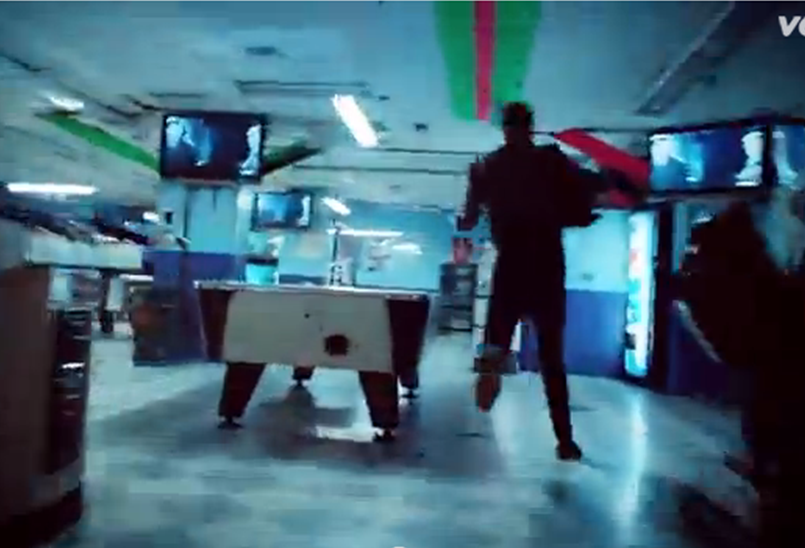
The next is the use of screens within the arcade as the artist runs through, the shot below shows just a few of the many screens that were shown in the video.
Finally, a mirror showing the artist's eyes was used towards the end of the video.
All of the above 3 references to looking are not as obvious as the use of black eyes, although they do still show a subconscious message to the audience of where they should look and what they should focus on.
Analysing- Bastille 'Pompeii'
The song I am analysing is by Bastille, and it is called 'Pompeii' Directed by: Jesse John Jenkins Genre: Indie Rock Characteristics of 'Indie Rock' within the video: Indie rock is known to be not compatible with mainstream tastes, and the 'Pompeii' video is very different from what you would usually see, for example it i has an unusual concept of people's eyes turning black which isn't a typical music video. As well as this the video looks fairly low budget, set in alleyways and in corner-shops and arcades, these are typical everyday settings, as opposed to big stages and expensive locations that the audience would be used to seeing in a music video. Goodwin's theory of music videos: Lyrics and Visuals:
There are many parts of the video in which the visuals are used to amplify the lyrics in the song.
the first example I can see is when the lyrics say 'But if you close your eyes', and you see 2 young girls look up to reveal their eyes which are blackened, and quite scary, a picture of this is shown below.
This amplifies the lyrics, adding something to them that the audience wouldn't necessarily think of if they were listening to the song without watching the video. It almost creates a sense of fear for the audience of what they are watching.
Another example is when the lyrics 'How am I gonna be an optimist about this?' are played and you see the artist struggling to find his way, desperately looking for a car to be able to get out of the situation he is in;
This shows the audience his thoughts at the time, it tells the audience that he is struggling to stay positive as he cannot escape the situation, again adding a visual to otherwise meaningless lyrics the audience would listen to.
There is a clip near the start of the video which says 'Many days fall away, with nothing to show', and it cuts between day and night during this sentence, as it says 'many days' it is light, and as it says 'fall away', it becomes dark, this all happens as the artist is walking down the stairs, so it is something that the audience would not initially notice watching the video, although is very clever in linking this visual to the lyrics on a subconscious level for the viewers.
Music and Visuals:
The pace of the music often links to the visuals in this video, for example as the music is slow and very simple during the part where it says 'Oh where do we begin?' as the audience see the artist lip syncing to the song, and slowly driving along (shown below);
This is quickly followed by seeing the artist getting agitated, hitting his steering wheel, appearing angry and getting out of his car as he then begins to hit the bonnet of his car, at the same time as this the music becomes more fast paced and intense as it says 'and the walls kept tumbling down'.
The video cuts with the beat of the song throughout most of the video, however there are some parts of it in which the beat contradicts the visual the viewers see on the screen. For example as the artist is running through the arcade, the music is at a fairly low tempo;
The music then becomes faster as he stops after seeing two girls at one of the arcade games, and nothing happens for several seconds as the backs of the girls are turned and the artist is staring at them, other than the tempo of the music raising, and drums begin to get louder.
The music tempo does change in time with the shots during this section although the visuals that the audience see are not ones that you would expect to go along with this kind of beat, as the beat is fast paced and the visuals are very simple, although the music may be being used as a build up for the audience seeing the two girls turn around.
Another example of the video cutting to the beat of the music, is at the start of the video as it cuts from a clip of the artist looking out of a window, where not very much is happening, to a clip of him singing as the singing starts in the song. The transition is very sudden, and the settings between these two clips is very different, making it more interesting for the audience to watch.
Artist Image:
In this video by Bastille, there are lots of close ups of the artist, showing his image very often, it is different from other videos Bastille has done, as this video almost shows a transformation of him. Below are some screenshots of the video of different shots and close ups of the artist.
These show the artist going through some kind of journey throughout the video, the concept of him gradually becoming one of the people we see through the video with blackened eyes is very unique, and shows him to be able to do acting as well as just singing. This shows more of what the artist can do, showing him to the audience in a different light than they are used to, advertising that he has more skills than just singing.
The 'Pompeii' music video relates to other Bastille music videos such as 'Flaws' in many ways. For example in the 'Flaws' video in several different ways. Both videos have unusual characters, such as in 'Pompeii' the people with blackened eyes, and in 'Flaws' it is people with their faces painted as skeletons. The screenshot below is from the 'Flaws' video.
As well as this, both videos are mainly focused on the one artist from Bastille, and have a similar dim lighting throughout the video, showing that the band is fairly consistent with their branding and image, and aren't going through any form of image change. The screenshot below is from the 'Flaws' video.